


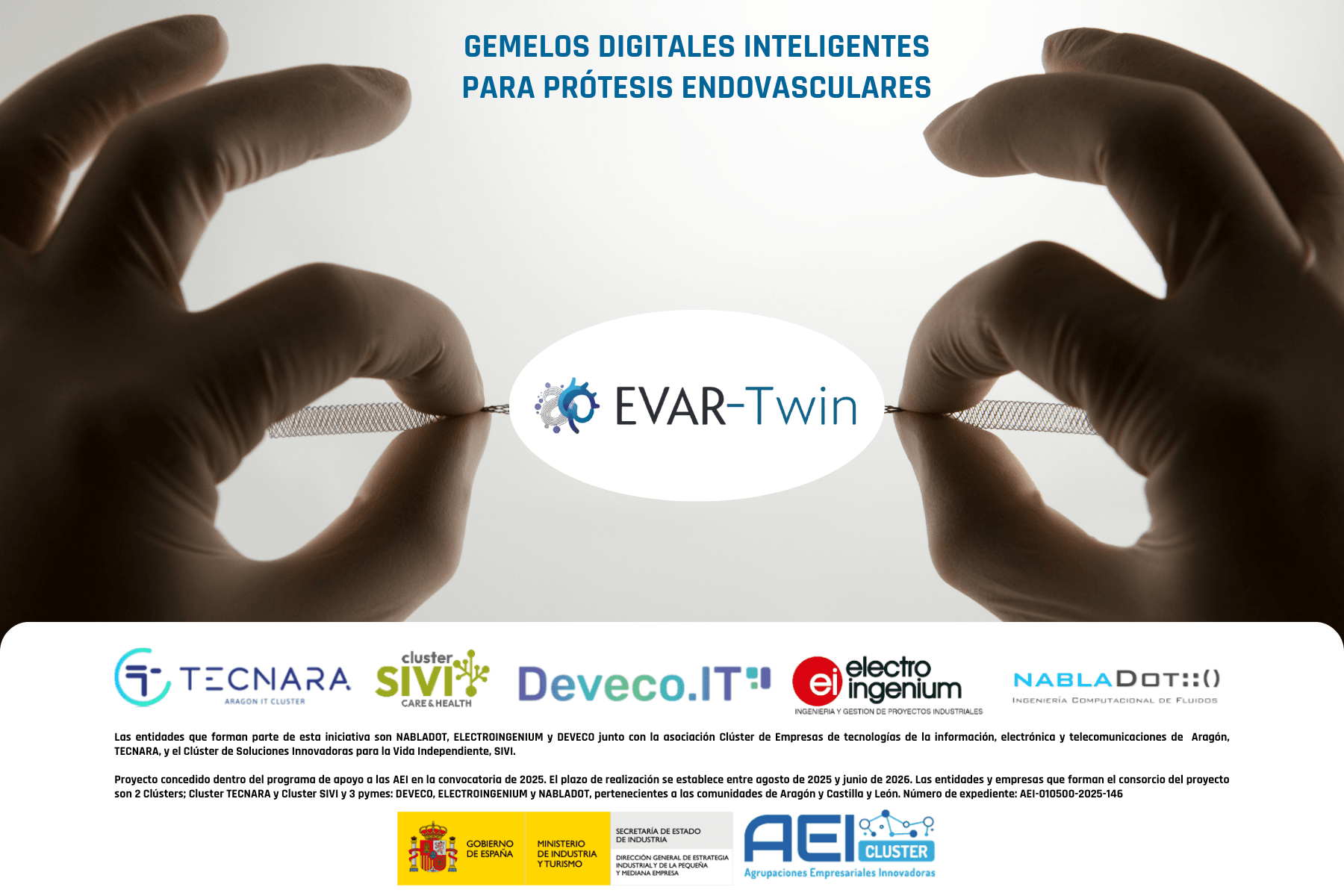
The EVAR-Twin project aims to develop a semi-automated clinical support tool for vascular surgeons, designed to assess how blood flow behaviour influences thrombus formation following endovascular repair procedures for abdominal aortic aneurysms (EVAR). It integrates advanced computational fluid dynamics (CFD) simulations, artificial intelligence techniques and automated medical image processing. The solution will enable the generation of patient-specific in silico models based on CT scans, MRI scans and simulation data, thereby facilitating the prediction of postoperative thrombogenic risk.
From a technical perspective, the platform fully automates the workflow: from the construction of three-dimensional models and the numerical solution of haemodynamic equations under realistic physiological conditions, to the processing and integration of results. State-of-the-art computational models will be incorporated to simulate the interaction between blood, stents and vascular walls, enabling the identification of areas at high risk of thrombosis. Furthermore, real clinical data will be integrated with the digital models to construct virtual patient twins, enabling the simulation of different therapeutic or clinical progression scenarios. Artificial intelligence is applied to both automated processing and predictive analysis, improving the capacity for early detection and risk stratification.
An innovative proposal with high added value
This tool enables healthcare professionals to make more informed and personalised decisions, potentially reduces rates of post-operative complications and optimises the use of clinical resources. Its automated design facilitates its integration into daily practice, making its adoption in hospitals and medical centres viable without the need for simulation experts. In the medium term, it could become a licensed product or be integrated as a module within digital medical platforms.
The project also has a strong social impact: it helps improve the quality of life and survival of patients with vascular diseases, enables more efficient healthcare management in the face of an ageing population, and strengthens collaboration between the technology and medical sectors.
The organisations involved in this initiative are NABLADOT, ELECTROINGENIUM and DEVECO, together with TECNARA and SIVI.
Consortium:

Co-funded project:
EVAR-Twin (file no.: AEI-010500-2025-146), with a budget of 164.846 €, is funded with 131.875 € by the Ministry of Industry and Tourism through the 2025 Innovative Business Groupings (AEI) support programme, with the aim of improving the competitiveness of small and medium-sized enterprises.
